Things Every Manager Should Know About AI
1. Introduction
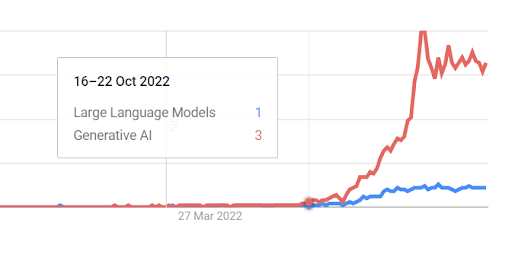
Although Artificial Intelligence has roots in the 1950s, its recent resonance makes it impossible to ignore. Since the 1990s, there's been a shift in perspective, with Machine Learning models becoming more efficient as they were fed increasing amounts of data, and stable hardware advancements leading to ever-improving results. It is precisely the analysis of big data that has enabled the research we discuss today: since around 2020, computing power has become economically sufficient to train Large Language Models¹.
2. Who Are the Top Players Today and What Do They Do
Today's top players include the five Big Tech companies: Microsoft, Google, Meta, Amazon, and Apple, alongside the major player OpenAI and leaders in generative images, Midjourney and StabilityAI (creators of Stable Diffusion). OpenAI was the first company to bring these technologies to the mass market and quickly proved stable and robust, releasing ChatGPT in November 2022, followed by GPT-3.5 Turbo, GPT-4, DALL-E 3, and the latest announcements presented at their DevDay in November.
Microsoft saw the opportunity and forged strong partnerships with OpenAI, releasing their services through Azure cloud tools and integrating their offerings with Bing. Google, long a leader in AI, especially in research, quickly adapted with a strong Google Cloud offering, providing developer tools and promising a cutting-edge model, Gemini. Meta, meanwhile, seems to be positioning itself as a pioneer, releasing models like LLama, which, although less efficient, are open-source and commercially licensed, making them very appealing for industrial use. Amazon has been quieter but made headlines with its acquisition of Anthropic in late September 2023, investing up to $4 billion.
3. The Impact and Opportunities of Generative AI
4. Application Cases
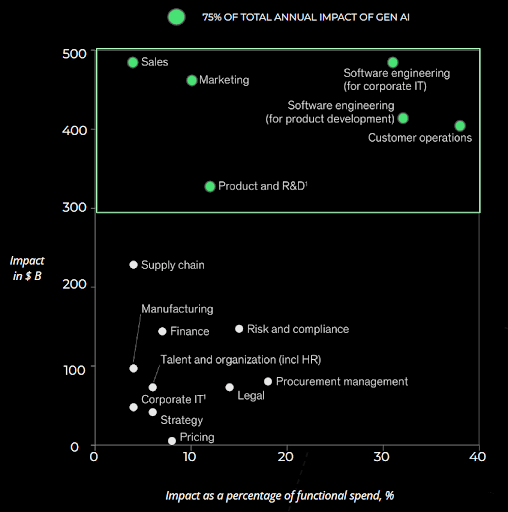
At Webranking, we moved quickly to fully harness the potential of Generative AI, creating internal use cases and proposing others to various clients. Digital Marketing is fertile ground for development in this field, and we foresee significant impacts in copywriting and creative work from these new technologies. It can be helpful to divide the application cases into three broad areas:
- Textual applications
- Image generation
- Traditional AI
- For example, the first area can be applied to generating copy for SEO and Advertising, managing product description creation from simple attributes, or even translating existing copy into dozens of languages instantly while maintaining the brand's correct tone of voice. Google itself, with its new Demand Gen ads, plans to integrate these technologies into its tools.
- The second area literally leaves more room for creativity, allowing not only the generation of entire campaigns, as some well-known brands have already done, but also more refined work, such as modifying the backgrounds of existing product shoots, thus enabling strong personalization.
- Traditional AI remains useful for all projects involving sales forecasting, inventory organization optimization, and other data-based cases.
As with all innovative projects, a method is necessary. Applying Generative AI technologies in Digital Marketing aims to increase productivity, so it's crucial to study current processes across various departments to optimize them, implement a Proof of Concept to validate an idea's viability, and then bring the project to production.
5. Conclusions
Fears of job replacement are not too different from those expressed for other technologies and are repeated cyclically. This is not science fiction but simply advancing technology that streamlines repetitive tasks. Technology evolves rapidly, and it's essential for managers to understand the context in which these players operate: greater productivity, faster execution, and higher work quality are just some of the benefits that artificial intelligence offers. In a context that will become increasingly competitive, it's crucial to explore all possibilities and delve into these technologies to stay up-to-date.
This article was written by Nicolò Gasparini, Innovation Team Manager.
Sources:
Wikipedia
Forbes
Fortune Business Insights
New York Times
Mckinsey
Blog Google
Forbes